
Thousands of college football players compete each year with hopes of reaching the NFL. To help student-athletes succeed on and off the field, the NFL works closely with the NCAA and BridgeAthletic to provide education, resources, and development opportunities. Through initiatives like the College Outreach Program and the College Advisory Committee, the NFL helps players understand their future in football while preparing for life beyond the game.
Education is something we value at the NFL. We understand players are dreaming of playing on Sunday, Monday and Thursday. But we also know it may be a short-lived experience and that there's nothing more valuable than your education.
COLLEGE OUTREACH PROGRAM
The NFL College Outreach Program goes far beyond preparing players for the NFL — it establishes a high standard of excellence for players to pursue on the field and in their personal lives.
As a part of this program, former NFL players visit colleges and universities to have frank discussions with student-athletes about what to expect at the next level, how the NFL Draft process works and how to make informed decisions as underclassmen.

NFL Legends, including Pro Football Hall of Famers Aeneas Williams and Cris Carter, along with NFL Executive Vice President of Football Operations Troy Vincent Sr., share their personal experiences to emphasize the value of a college education. They remind student-athletes how difficult it is to reach the NFL and how brief most playing careers are, highlighting the connection between success in the classroom and success in life.
By age 25, most NFL players will have no more economic use for the only skill they ever developed. An NFL career is a magic ticket for very few superstars.
TAKING THE NEXT STEP
The NFL’s player development process doesn’t end when a student-athlete's collegiate career comes to an end. Top prospects showcase their talents for scouts at events like the Senior Bowl, East-West Shrine Bowl, American Bowl, and National Showcases.
The league also connects former players with opportunities for careers in coaching, scouting, and officiating — recognizing the unique skillset and passion for the game that former players possess. Initiatives like the NFL Coaching Workshop, Officiating Development Program, Bill Walsh Minority Coaching Fellowship and Nunn-Wooten NFL Scouting Fellowship allow former players the chance to keep their NFL dream alive.
WHO’S NEXT?
The NFL and the NCAA work closely to educate student-athletes. If a collegiate player has what it takes — the talent, the commitment, and the dedication — then the NFL will find them regardless of what level they are currently playing in college (FBS, FCS, DII, etc.)
Still, only 1.6% of college football players will ever play professionally, but academic scholarships and college educations will give many others the tools they need to succeed in life. The NFL is committed to making sure college football players make the most of these opportunities — which extends beyond the game.
College Advisory Committee
To some, the NFL Draft serves as the “final exam” for measuring the skill that each club has at determining and choosing talent.
Clubs draw from thousands of scouting reports, medical evaluations, and personal interactions to decide which players can turn around a franchise or fill gaps to make a good team into an exceptional one.
Before clubs select a single player, NFL Football Operations goes through an exhaustive process of verifying players’ draft eligibility. This means that the NFL’s Player Personnel department researches and verifies the educational and athletic participation history of thousands of players that may be eligible for the Draft. League staff review college teams’ media guides and websites, contact college coaches, compliance officers and football administrators, and communicate with the student-athletes.
In recent years, the number of underclassmen who have applied to gain early entry into the Draft (“special eligibility”) has steadily increased. In certain cases, it may be the player’s best move; in most, though, the player may be drafted lower than he anticipated, or not at all. In these cases, the player has now forfeited the rest of his college eligibility and has given up his best chance to earn a degree while improving his football skills.
Learn more in the NFL's Head Coach's Guide to the College Advisory Committee.
Only 1.6% of all NCAA football players ever make it to the professional level.
To help both the clubs, who want NFL-ready players in the Draft, and the student-athletes, who are looking to enter the Draft early, the NFL relies on its College Advisory Committee. The Committee, which includes high-level personnel evaluators from NFL clubs and directors from the league’s two sanctioned scouting organizations (National Football Scouting and BLESTO), advises underclassmen on their draft prospects before they make a formal request to the league to join the Draft.
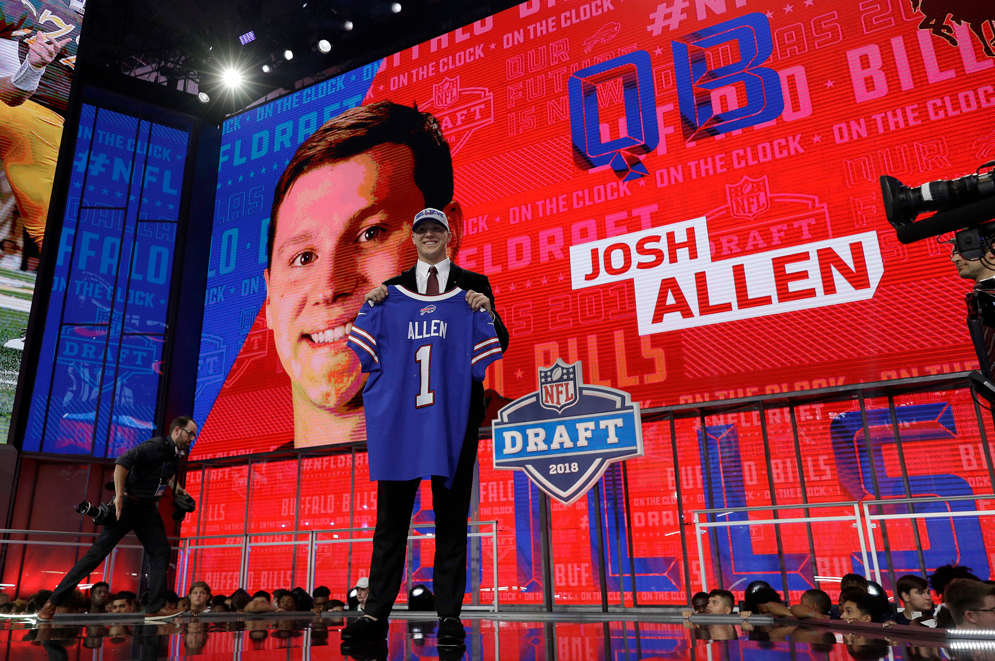
Wyoming's Josh Allen poses with his Buffalo Bills jersey during the first round of the NFL football draft, Thursday, April 26, 2018, in Arlington, Texas. (AP Photo/David J. Phillip)
AP
The College Advisory Committee’s process for determining whether underclassmen are ready for the NFL changed in 2014. Under the revised NFL guidelines, a college can request evaluations for only five players, with exceptions determined on a case-by-case basis; previously, there was no limit on the number of players from one team who could be reviewed.
The ratings system was revised as well. In previous years, the Committee would evaluate players in one of five categories: potential first-round pick, potential second-round pick, potential third-round pick, no potential for the first three rounds or no draft potential at all.
The new ratings are much simpler: potential first round, potential second round, or neither, which is effectively a recommendation to stay in school.
If a student-athlete’s goal is to play in the NFL, his best chance at success may be to stay in school, earn his education, improve his Draft position and complete his college football eligibility.
“While some like to debate the advantages of declaring early for the draft, one thing is for certain: Completing your education affords you more opportunity and financial freedom beyond football.”
TROY VINCENT, Sr., EXECUTIVE VICE PRESIDENT, NFL FOOTBALL OPERATIONS
Ahead of the 2024 NFL Draft, 17 student-athletes were given first- or second-round evaluation. 13 of the 14 who declared for the Draft were drafted in the first two rounds.
The College Advisory Committee is extremely accurate when evaluating first- or second-round prospects who declare for the Draft.
First 2 round accuracy
| Year | Evaluation Accuracy | Drafted in first two rounds |
| 2024 | 92.9% | 13/14 |
| 2023 | 88.2% | 15/17 |
| 2022 | 94.1% | 16/17 |
| 2021 | 91.7% | 11/12 |
| 2020 | 96.0% | 24/25 |
| 2019 | 84.2% | 16/19 |
| 2018 | 76.2% | 16/21 |
| 2017 | 90.9% | 20/22 |
| 2016 | 76.0% | 19/25 |
| 2015 | 90.0% | 18/20 |
| 2014 | 90.9% | 20/22 |
| Total | 87.9% | 188/214 |
In 2024, 93 players were advised to remain in school by the College Advisory Committee (third-round grade or below). 22 of those 93 players declared for the 2024 NFL Draft after being advised to remain in school.
Getting better with age
| Player | Pos. | College | Evaluation | Draft Year | Overall Selection | Club |
| Troy Fautanu | T | Washington | Remain in school | 2024 | 20 | PIT |
| Jack Campbell | LB | Iowa | Remain in school | 2023 | 18 | DET |
| Calijah Kancey | DT | Pittsburgh | Remain in school | 2023 | 19 | TB |
| Nolan Smith | LB | Georgia | Remain in school | 2023 | 30 | PHI |
| Jordan Davis | DT | Georgia | Remain in school | 2022 | 13 | PHI |
| Jahan Dotson | WR | Penn State | Remain in school | 2022 | 16 | WAS |
| Devin Lloyd | LB | Utah | Remain in school | 2022 | 27 | JAX |
| DeVonta Smith | WR | Alabama | Remain In School ('20) | 2021 | 10 | PHI |
| Rashawn Slater | T | Northwestern | Remain In School ('20) | 2021 | 13 | LAC |
| Alijah Vera-Tucker | G | Southern California | Remain In School ('20) | 2021 | 14 | NYJ |
| Alex Leatherwood | T | Alabama | Remain In School ('20) | 2021 | 17 | LV |
| Kwity Paye | DE | Michigan | Remain In School ('20) | 2021 | 21 | IND |
| Najee Harris | RB | Alabama | Remain In School ('20) | 2021 | 24 | PIT |
| Eric Stokes | DB | Georgia | Remain In School ('20) | 2021 | 29 | GB |
| Isaiah Simmons | LB | Clemson | Remain In School ('19) | 2020 | 8 | AZ |
| Jordyn Brooks | LB | Texas Tech | Remain In School ('19) | 2020 | 27 | SEA |
| Josh Allen | DE | Kentucky | Remain In School ('18) | 2019 | 7 | JAX |
| Jerry Tillery | DT | Notre Dame | Remain In School ('18) | 2019 | 28 | LAC |
| Deandre Baker | DB | Georgia | Remain In School ('18) | 2019 | 30 | NYG |
| Kaleb McGary | T | Washington | Remain In School ('18) | 2019 | 31 | ATL |
| Baker Mayfield | QB | Oklahoma | Remain In School ('17) | 2018 | 1 | CLE |
| Josh Allen | QB | Wyoming | Remain In School ('17) | 2018 | 7 | BUF |
| Frank Ragnow | C | Arkansas | Remain In School ('17) | 2018 | 20 | DET |
| Billy Price | C | Ohio State | Remain In School ('17) | 2018 | 21 | CIN |
| Hayden Hurst | TE | South Carolina | Remain In School ('17) | 2018 | 25 | BLT |
| Rashaad Penny | RB | San Diego State | Remain In School ('17) | 2018 | 27 | SEA |
| Sony Michel | RB | Georgia | Remain In School ('17) | 2018 | 31 | NE |
| Corey Davis | WR | Western Michigan | Remain In School ('16) | 2017 | 5 | TEN |
| O.J. Howard | TE | Alabama | Remain In School ('16) | 2017 | 19 | TB |
| Evan Engram | TE | Mississippi | Remain In School ('16) | 2017 | 23 | NYG |
| Sheldon Rankins | DT | Louisville | Remain In School ('16) | 2017 | 12 | NO |
| Karl Joseph | DB | West Virginia | Remain In School (‘15) | 2016 | 14 | OAK |
| Josh Doctson | WR | Texas Christian | Remain In School (‘15) | 2016 | 22 | WAS |
| William Jackson | DB | Houston | Remain In School (‘15) | 2016 | 24 | CIN |
| Vernon Butler | DT | Louisiana Tech | Remain In School (‘15) | 2016 | 30 | CAR |
| Germain Ifedi | T | Texas A&M | Remain In School (‘15) | 2016 | 31 | SEA |
The average draft position of these players was consistent with the evaluations provided by the NFL clubs.
Players Given a Remain-in-School Evaluation
| Players Given a Remain-in-School Evaluation | ||
| Round Selected | 2023 | 2024 |
| 1 | 0 | 0 |
| 2 | 1 | 7 |
| 3 | 2 | 3 |
| 4 | 1 | 7 |
| 5 | 5 | 3 |
| 6 | 3 | 1 |
| 7 | 4 | 0 |
| Undrafted | 5 | 1 |
| Weighted Draft Avg. | 5.86 | 3.64 |
Since 2012, 87.9% of student-athletes who received a first- or second-round evaluation and declared for the Draft have been selected in the first two rounds.
“We want the student-athlete to make an informed decision,” said Troy Vincent, Sr. executive vice president of NFL Football Operations. “Use our resources and make an informed decision. Each institution has those resources for every prospect and every head coach. The numbers and the facts speak for themselves.”
The NFL encourages most underclassmen to finish their college eligibility and earn a degree while maturing as a professional prospect. Participating in the Draft means that an underclassman loses his remaining eligibility: If he is not selected by an NFL team, he will not be able to play another college season and he will not be able to improve his draft standing for the following year’s draft.
“Declaring for the Draft doesn’t guarantee success in the NFL,” said Vincent. “A College Advisory Committee evaluation will assist you in making an informed decision.”
College All-Star Games
These partnerships help strengthen communities and develop a strong pipeline of football talent.
Both annual college showcases supported by the NFL — the East-West Shrine Bowl and Senior Bowl — impact the community through charitable causes. Created by the Shriners in 1925, the East-West Shrine Bowl supports Shriners Hospitals for Children. The Senior Bowl, founded in 1950 and based in Mobile, AL, benefits various local and regional organizations.
“All-star games are excellent developmental opportunities for prospects, NFL position coaches, and support staff,” said Troy Vincent, Sr., NFL Executive Vice President of Football Operations.
Both all-star games will utilize the same professional development model of blended staff. To achieve equity for our club members, NFL Football Operations requests the nomination of assistant coaches from clubs (position coaches, unit assistants, and quality control) for consideration for the all-star opportunity. Coaches will gain coaching experience up or across a level and will be challenged to work with that year’s pool of prospects as a head coach, coordinator, or position coach. In these elevated roles, coaches will be better prepared as leaders and developers of young talent on and off the field.
A committee, including NFL Football Operations Staff and three General Managers from the General Managers Advisory Committee, will select the coaching staff.
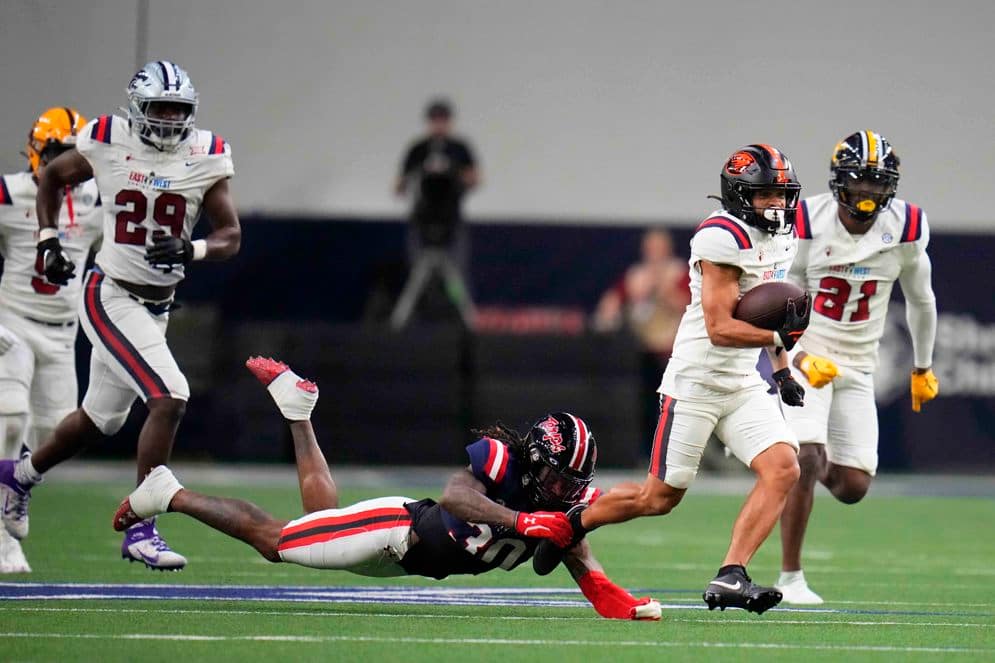
East's Anthony Gould, second from right, of Oregon State, avoids a tackle by West's Ja'Quan Sheppard, of Maryland, on his way to scoring on a punt return during the second half of the East West Shrine Bowl NCAA college football game in Frisco, Texas, Thursday, Feb. 1, 2024. (AP Photo/Julio Cortez)
AP
East-West Shrine Bowl
With 100 years of history, the East-West Shrine Bowl is the longest-running college all-star event. It focuses on player physical and mental health, wellness, sleep and recovery resources, and a best-in-class interview process. The Shrine Bowl has recently given players like Zay Flowers, Isaiah Pacheco, and Brock Purdy the chance to showcase their talents. The NFL provides the coaching staff, game officials, video staff, and four Legends captains, giving emerging assistant coaches valuable experiences and opportunities to showcase their skills.
Senior Bowl
The NFL supports the Senior Bowl by providing video personnel from various clubs to assist with football operations and using the game week platform to train and develop NFL officials. Notable Senior Bowl alumni include Joe Namath, Walter Payton, Dan Marino, and current stars Josh Allen and Jalen Hurts.
The Senior Bowl supports local communities through initiatives like the Senior Bowl Ambassador Club and the Mobile/Baldwin Athletic Partnership (MBAP), which donates to underfunded high school football programs. Other projects include an NFL Flag League for kids, the annual Turkey Bowl, and holiday meal distributions with Feeding the Gulf Coast.
Members of the NFL’s Legends community and team player engagement personnel mentor players for both games throughout the week. Through these initiatives, the NFL ensures that both the East-West Shrine Bowl and Senior Bowl continue to serve as key developmental platforms for future NFL talent while making significant contributions to their respective communities.
College Administrators
Beyond players, the NFL supports the growth and development of football administrators.
The NFL and NACDA host a specialized General Manager Programming Track at the NACDA & Affiliates Convention, designed for collegiate athletics professionals serving in the evolving GM role. As the intercollegiate athletics landscape continues to evolve and general managers become integral to program success, these sessions aim to educate those individuals currently navigating the position as well as leaders who are looking to support and fill these positions on college campuses.
The NFL/NCAA Administrators Academy prepares the next generation of football administrators through immersive leadership development and hands-on mentorship. Designed for graduate assistants and interns, the academy equips aspiring administrators with the skills and resources needed to thrive in college and professional football, with programming shaped by NFL clubs, conference offices and industry leaders.
The NFL partners with FBS & FCS football programs to create an advisory committee consisting of selected athletic administrators across the country. The College Administrator Committee collaborates with the NFL to provide feedback on digital and in-person engagement opportunities, identify strategies to enhance college outreach efforts and develop effective solutions to support the college football player pathway.